Welcome, savvy marketer. You’re not here for the basic “set your keywords and forget it” advice. You’ve likely read those surface-level Google Ads tips and found them lacking. You’re here because you understand that Google Ads is a sophisticated, dynamic chess match, not a game of checkers. You’re ready to move beyond the fundamentals and into the realm of strategic mastery.
This guide is engineered for those who want to build a truly dominant, resilient, and highly profitable campaign. We will delve into the nuanced strategies that most blogs gloss over—the psychological triggers, the data-deep dives, and the architectural frameworks that separate the top 1% of advertisers from the rest. Consider this your advanced playbook.
Let’s begin.
Part 1: The Foundational Mindset – Building for Resilience & Profit
Before a single keyword is typed, the most successful advertisers adopt a specific mindset. It’s not about getting more clicks; it’s about attracting the right customers at the lowest possible cost.
Google Ads Tip #1: Define “Success” Beyond Clicks and Impressions.
Your primary Key Performance Indicators (KPIs) should be Cost Per Acquisition (CPA) and Return on Ad Spend (ROAS). A campaign with a million clicks is a failure if it doesn’t generate profitable conversions. From day one, install conversion tracking and Google Analytics 4. Know your numbers: what is a customer worth to you? What is your target CPA? Without this, you’re flying blind.
Google Ads Tip #2: Embrace the “Un-Glamorous” Work of Account Structure.
This is the most critical, yet most overlooked, of all advanced Google Ads tips. A messy structure leads to wasted spend and incoherent data. Implement a Single Theme Per Ad Group (STAG) structure. Each ad group should be a hyper-focused cluster around one core keyword theme, with tightly related keywords, and ads that speak directly to that theme’s search intent.
- Bad Structure: An ad group called “Running Shoes” containing keywords for “best running shoes for flat feet,” “cheap running shoes,” and “Nike Air Max.”
- Good (STAG) Structure:
- Ad Group 1: “Running Shoes for Flat Feet” (Keywords: stability running shoes, overpronation shoes, best shoes for flat arches)
- Ad Group 2: “Budget Running Shoes” (Keywords: cheap running shoes, running shoes under $50, discount running shoes)
- Ad Group 3: “Nike Air Max” (Keywords: buy nike air max, air max 90 sale, nike air max price)
This allows for precise Quality Score management, relevant ad copy, and clear data analysis.
Google Ads Tip #3: Master the Sales Funnel.
Not all searchers are ready to buy. Your strategy must differ for each stage:
- Top of Funnel (Awareness): Users are researching. Use Google’s Discovery Ads, YouTube TrueView for awareness, and Display campaigns with tailored audiences. The goal here is education and brand awareness, not direct sales. Bid lower and use broader keywords.
- Middle of Funnel (Consideration): Users know their problem and are evaluating solutions. Use Search campaigns with more specific keywords (“best CRM for small business,” “hubspot vs salesforce”). Remarketing is your most powerful tool here.
- Bottom of Funnel (Conversion): Users are ready to buy or sign up. Use high-intent keywords (“buy,” “price,” “deal,” “discount code”) and maximize your Remarketing efforts with dynamic ads showcasing products they’ve already viewed.
Part 2: Keyword Alchemy – Transforming Clicks into Conversions

Keywords are the bridge between user intent and your offer. Most people build a wobbly rope bridge; we’re building a steel suspension bridge.
Google Ads Tip #4: Go Beyond Broad Match (The Smart Way).
The classic advice is to use only Exact Match. The modern, advanced approach is to use a Broad Match + Smart Bidding combination, but only with a robust foundation. Broad Match, powered by Google’s AI, can find new, valuable search queries you’d never think of. However, you must pair it with a super-targeted Smart Bidding strategy (like Target ROAS or Maximize Conversions) and a extensive, meticulously built Negative Keyword list. This allows the AI to explore while you guard against irrelevant traffic.
Google Ads Tip #5: Implement “Mining” as a Core Discipline.
Your greatest source of new Google Ads tips and keywords is your own account data.
- Search Terms Report Mining: Weekly. This is non-negotiable. Analyze every single search term that triggered your ad. Add converting terms as keywords. Add irrelevant terms as negative keywords. This is how you refine your targeting to surgical precision.
- Competitor Keyword Mining: Use tools like Semrush or Ahrefs to see what keywords your successful competitors are ranking for organically and bidding on in ads. Don’t copy; analyze for opportunities they might be missing.
Google Ads Tip #6: Leverage the Power of Audience-Based Keywords.
Use audiences not just for targeting, but for insight. Add high-intent audiences (like “Remarketing,” “Customer Match,” “In-Market”) as Observation to your Search campaigns. Analyze which keywords are driving conversions from these premium users. Then, create dedicated campaigns or ad groups specifically targeting these audiences with hyper-relevant ad copy for those high-performing keywords.
Part 3: Ad Copy That Converts – The Art & Science of the Click

Your ad is your first date with a potential customer. Make it count.
Google Ads Tip #7: Write for the “Skimmer,” Not the Reader.
Online attention spans are measured in seconds. Use clear, scannable formatting:
- Title-Led Value Proposition: Lead with the biggest benefit.
- Symbols & Numbers: → “Increase Conversions by 35%” ←
- Sentence Fragments are OK: As long as they are clear and impactful.
Google Ads Tip #8: The RSA (Responsive Search Ad) “Fill-Every-Asset” Rule.
Google’s AI needs data to optimize. Never leave an RSA asset blank. Provide the maximum number of headlines (15) and descriptions (4). Use Pinning strategically to lock your most critical value proposition (e.g., “Free Shipping”) in position 1, but allow the AI to mix and match the others to find winning combinations.
Google Ads Tip #9: Implement Ad Copy Psychological Triggers.
Move beyond features to touch on deep-seated psychological drivers.
- Scarcity & Urgency: “Limited Spots,” “Sale Ends Tonight,” “Only 3 Left in Stock.”
- Social Proof: “Join 10,000+ Happy Customers,” “Bestselling Solution of 2023.”
- FOMO (Fear Of Missing Out): “Don’t miss out on this exclusive offer.”
- Authority: “Industry-Leading Technology,” “Award-Winning Support.”
Test these triggers in your ad variations to see what resonates with your audience.
Google Ads Tip #10: Use Sitelink Assets as Your Mega-Menu.
Sitelinks are not just an extension; they are a navigational tool to shortcut the user journey. Don’t use generic “Learn More.” Be specific: “View Spring Collection,” “See Pricing Plans,” “Download the Whitepaper,” “Get a Free Consultation.” Each sitelink should target a different user intent and stage in the funnel.
Part 4: Bidding & Budget Mastery – Letting AI Work for You

Bidding is where profit is made or lost. The old manual bidding ways are largely obsolete.
Google Ads Tip #11: Trust Smart Bidding, But Verify.
Strategies like Target ROAS and Maximize Conversions are incredibly powerful. They analyze millions of data points in real-time to bid for you. However, your job is to provide the AI with three things:
- Clean Data: A well-structured account with accurate conversion tracking.
- Time: At least 2-4 weeks of learning period without major changes.
- The Right Goal: A realistic target ROAS or CPA based on historical data.
Google Ads Tip #12: Use Portfolio Bid Strategies for Unified Management.
If you manage multiple campaigns with the same goal (e.g., five different campaigns all driving leads), use a single Portfolio Bid Strategy. This allows the AI to allocate budget across all campaigns dynamically, moving funds to where conversions are most likely to happen at your target CPA, rather than being siloed.
Google Ads Tip #13: Implement Dayparting & Device Bid Adjustments After Smart Bidding.
With Smart Bidding, Google automatically adjusts bids for time of day and device. However, once you have significant data, you can still analyze performance reports. If you consistently see that conversions from mobile between 7-10 PM have a CPA 50% lower than average, you can create a separate campaign with a higher target ROAS (or lower target CPA) specifically for that time and device, letting the AI bid even more aggressively.
Google Ads Tip #14: The “Spend Efficiency” Rule for New Campaigns.
When launching a new campaign, don’t start with a low budget and a super aggressive Smart Bidding strategy. The AI needs data. Instead, set your bid strategy to Maximize Clicks (with a reasonable max CPC cap) for the first 1-2 weeks. This will gather initial data on what clicks cost and what converts. Then, switch to a Maximize Conversions strategy (with a optional CPA cap) to start optimizing for volume efficiently.
Part 5: The Unfair Advantage: Advanced Audience Strategies

Audiences are the key to personalization and efficiency.
Google Ads Tip #15: Layer Audiences on Search Campaigns.
This is a game-changer. Apply audiences (e.g., “In-Market,” “Remarketing Lists,” “Affinity”) to your Search campaigns in Observation mode. This doesn’t change who sees your ad, but it allows you to see performance data by audience. You might discover that “In-Market” users convert at 5x the rate of the general population. Once you know this, you can create a separate campaign targeting that specific audience with a higher bid adjustment or a more aggressive bidding strategy.
Google Ads Tip #16: Build a Hyper-Specific Remarketing Funnel.
Don’t just have one “All Website Visitors” list. Segment your remarketing:
- Tier 1 (Hottest): Users who added to cart but didn’t checkout. Show them dynamic remarketing ads with the exact products and a strong offer (e.g., “10% Off Your Order!”).
- Tier 2 (Warm): Users who visited key product pages (spent > 30 seconds). Show them testimonials or ads for the category they were browsing.
- Tier 3 (Cool): All website visitors. Focus on general brand awareness and top-of-funnel content.
Google Ads Tip #17: Utilize Customer Match for Prospecting.
Upload your customer email list to create a “Customer Match” audience. Then, use this to build a Lookalike Audience (Similar Segments). Google will find new users who share characteristics with your best existing customers. This is often your highest-quality prospecting audience.
Google Ads Tip #18: Target by Life Events.
A profoundly powerful but underused feature. You can target people based on major life events like “Recently Married,” “Moved,” “Graduated,” or “Retired.” The intent and commercial needs of these users are incredibly high. A bank could target recent movers with mortgage ads; a furniture store could target them with living room set ads.
Part 6: Beyond Search – Dominating the Entire Google Ecosystem

Victory is achieved on multiple fronts.
Google Ads Tip #19: YouTube for Action, Not Just Views.
Stop thinking of YouTube as a brand-awareness-only channel. Use YouTube Action Campaigns with precise intent-based targeting (e.g., Custom Intent audiences based on keywords of products your prospects would research) and a strong, direct-response-oriented video ad. Place your compelling offer right in the video and use the CTA overlay.
Google Ads Tip #20: Discovery Ads for the Visual Funnel.
Discovery ads are visual, native, and appear in Gmail, YouTube Home, and the Discover feed. They are perfect for the top and middle of the funnel. Use high-quality lifestyle imagery and focus on a problem/solution dynamic. The goal is to drive a high-quality click to a relevant blog post or landing page, not necessarily a direct sale.
Google Ads Tip #21: Performance Max for Amplification.
PMax is a powerful but often misunderstood beast. Do not use it as a “set it and forget it” campaign. Use it to amplify your successful assets.
- Feed Quality is King: Your product feed (for e-commerce) or your landing pages (for leads) must be impeccable.
- Use Audience Signals: Feed PMax your best-performing first-party data (customer lists, website converter lists) as signals to guide the AI.
- Asset Diversity: Provide a wide array of high-quality images, videos, logos, and text. PMax thrives on creative options.
Google Ads Tip #22: Don’t Neglect the Google Display Network (GDN) for Remarketing.
While Search captures intent, GDN Remarketing creates intent. Use visually stunning image or responsive display ads to stay top-of-mind as your prospects browse other websites. The frequency cap is your friend here—don’t annoy them into ad blindness.
Part 7: The Optimization Engine – From Data to Decisions
A campaign is a living entity. It requires constant care and feeding.
Google Ads Tiphttps://hawksem.com/blog/optimizing-google-ads/ #23: Schedule a “Power Hour” Weekly.
Dedicate one hour each week to nothing but account analysis. Go through:
- Search Terms Report (add negatives, find new keywords).
- Performance by Ad Group & Keyword (pause underperformers, adjust bids).
- Asset Report in RSAs (identify best-performing headlines/descriptions).
- Check for any disapprovals or errors.
Google Ads Tip #24: Embrace A/B Testing Relentlessly.
Always be testing. One ad variation per ad group is not enough. Test:
- Value Propositions: “Free Shipping” vs. “Lifetime Warranty”
- CTAs: “Buy Now” vs. “Get Started” vs. “Learn More”
- Urgency: “Sale Ends Soon” vs. “Limited Time Offer”
Use a proper testing methodology and wait until you have statistically significant results before declaring a winner.
Google Ads Tip #25: The “Quality Score” Deep Dive.
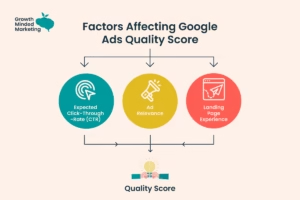
Don’t just glance at the 1-10 score. Click into the diagnostic. Is your “Expected Clickthrough Rate” low? Your ad copy or keyword relevance might be weak. Is your “Landing Page Experience” poor? Your page might be slow, irrelevant, or have a weak offer. Treat each component as a separate puzzle to solve.
Google Ads Tip #26: Use Annotations.
Document everything directly in Google Ads. Use annotations to note when you launched a new campaign, changed a bidding strategy, ran a major sale, or even when an external event (like a holiday) might have impacted performance. This provides crucial context when analyzing performance trends months later.
Part 8: The Final Frontier – Next-Level & Experimental Strategies
These Google Ads tips are for those with a solid foundation looking for an extra edge.
Google Ads Tip #27: Local Services Ads Supremacy (For Service Businesses).
If you are a plumber, electrician, locksmith, etc., Local Services Ads (LSA) are often far superior to standard Search ads. You pay per lead (not click), you get a “Google Guaranteed” badge, and you appear above all other ads. The barrier to entry (background checks, licensing) also reduces competition.
Google Ads Tip #28: Dynamic Search Ads (DSA) for Content-Rich Sites.
Have a website with hundreds of blog posts or product pages? A DSA campaign can automatically generate headlines and target searches based on your website’s content. It’s fantastic for capturing long-tail queries you haven’t manually added. Use it with a conservative bid and a tightly themed landing page structure.
Google Ads Tip #29: Geo-Targeting Adjustments Based on Performance.
Pull a report by geographic location (city, postal code). You will almost certainly find that certain areas have a significantly higher conversion rate or lower CPA. Create location-based bid adjustments to bid more in profitable areas and less (or exclude entirely) in unprofitable ones.
Google Ads Tip #30: Integrate with Google Analytics 4 (GA4) for a 360° View.
The final, and perhaps most important of all advanced Google Ads tips, is to break down the silo. Link your Google Ads and GA4 accounts. Analyze the full customer journey. Which campaigns assist conversions? What is the true multichannel ROAS? Use GA4’s powerful audience-building tools (based on specific user behaviors) and export them directly to Google Ads for targeting.


Conclusion: The Cycle of Mastery
Implementing these Google Ads tips is not a one-time task. It’s the beginning of a continuous cycle: Implement -> Measure -> Analyze -> Optimize -> Repeat. The landscape of paid search is always shifting. New competitors emerge, customer behavior evolves, and Google’s platform updates.
The advertisers who win are not those with the biggest budgets, but those with the deepest understanding, the most meticulous approach, and the willingness to constantly test and learn. They treat their Google Ads account not as a cost center, but as a direct line to their customer’s intent and a predictable engine for growth.
Google Ads is a powerful Pay-Per-Click (PPC)https://sherinn.in/pcc-vs-seo-2024-digital-marketing-guide/ platform that allows businesses to gain immediate visibility on search engines by targeting specific keywords and audiences. Unlike SEO, which builds long-term organic traffic through optimized content, backlinks, and website authority, Google Ads delivers instant results and measurable performance data. When used together, PPC and SEO complement each other: insights from Google Ads campaigns—such as high-performing keywords and audience behavior—can inform SEO strategies, while strong SEO efforts can reduce the overall cost of paid campaigns by improving quality scores and clickthrough rates. By integrating Google Ads with a robust SEO approach, businesses can maximize reach, drive targeted traffic, and achieve both short-term and long-term growth.
Now, open your account, pick one tip to implement today, and start building your advantage.