
Digital Branding is a term thrown around in boardrooms and coffee shops alike, often reduced to a sleek logo, a consistent color palette, and a active social media presence. But this is a catastrophic oversimplification. True Digital Branding is not a project with a start and end date; it is a continuous, living, breathing odyssey. It’s the intricate process of weaving your company’s soul into the digital fabric of the internet, creating a resonant, psychological contract with your audience that transcends transactions and fosters community.
In an age where consumers are ruthlessly savvy and competition is just a click away, your digital branding strategy is your most valuable asset. It’s your differentiator, your reputation, and your promise. This definitive guide will take you on a deep dive into the layers of modern digital branding, moving beyond the superficial to explore the neuroscience, strategy, and soul required to build a brand that doesn’t just exist but truly lives online.
Deconstructing the Digital Brand: It’s Not What You Sell, It’s Why You Exist

Before we build, we must understand. A brand is not a product. Apple doesn’t sell computers; it sells innovation, creativity, and thinking differently. Nike doesn’t sell shoes; it sells aspiration, achievement, and the athlete in all of us. Your digital branding efforts must start with this core philosophical foundation: your Why.
- The Core Identity: This is your brand’s DNA. It encompasses your mission (your purpose), your vision (your aspirational future), your values (your guiding principles), and your unique value proposition (why you, and not someone else?). This isn’t just a paragraph for your “About Us” page; it’s the litmus test for every decision you make, from your content topics to your customer service policies.
- Brand Archetypes: Rooted in Jungian psychology, brand archetypes are a powerful tool for digital branding. Are you a Sage (Google, providing knowledge)? A Hero (Nike, overcoming challenges)? A Jester (Old Spice, bringing humor and unpredictability)? Choosing an archetype provides a timeless framework for your messaging, tone, and personality, ensuring consistency and deeper psychological connection.
- The Brand Promise: This is the single most important takeaway a customer should have from every interaction with you. Is it reliability? Luxury? Empowerment? Your entire digital branding ecosystem must be engineered to deliver on this promise, every single time.
The Digital Branding Ecosystem: Your Multichannel Universe
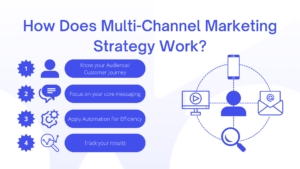
Your brand doesn’t live in a vacuum. It inhabits a dynamic ecosystem of owned, earned, and paid channels. A cohesive digital branding strategy seamlessly integrates them all.
- The Cornerstone: Your Website
Your website is your digital headquarters. It’s the one asset you fully own and control, making it the heart of your digital branding efforts.
- Design & User Experience (UX): Your site must be visually stunning (reflecting your brand identity) and intuitively easy to use. A confusing navigation or slow load time directly damages brand perception. It signals a lack of care and professionalism.
- Content & Voice: The words on your site are your brand speaking. Is your tone formal and authoritative? Friendly and conversational? Witty and sarcastic? Your brand voice must be consistent across every page, from product descriptions to your 404 error page.
- Storytelling: Use your website to tell your story. A powerful “Our Story” page that connects with your mission can be more effective than a dozen product pages.
- The Megaphone: Content Marketing
Content is the vehicle for your digital branding. It’s how you provide value, build trust, and demonstrate expertise without directly selling.
- Blog (Just like this one!): A blog is essential for SEO and establishing thought leadership. It allows you to explore topics relevant to your audience, embedding your digital branding philosophy into helpful, informative, or entertaining content.
- Video: Video is the king of content. Behind-the-scenes footage, tutorials, customer testimonials, and live Q&As humanize your brand and create powerful emotional connections.
- Podcasts & Webinars: These long-form content formats allow for deep dives into complex topics, positioning your brand as a definitive authority in your space.
- The Social Pulse: Social Media Presence
Social media is where your digital branding becomes a dialogue. It’s a listening post, a community hub, and a customer service channel rolled into one.
- Platform Selection: Don’t be everywhere. Be where your audience is. A B2B brand might thrive on LinkedIn, while a lifestyle brand might focus on Instagram and TikTok. Your choice of platform is a strategic digital branding decision.
- Authentic Engagement: It’s not enough to just post. You must engage. Respond to comments, ask questions, run polls, and join conversations. Authenticity is the currency of social media, and it’s non-negotiable for modern digital branding.
- User-Generated Content (UGC): Encourage your customers to create content for you. Reposting customer photos and reviews is the ultimate form of social proof and makes your customers feel like part of your brand’s story.
- The Trust Engine: Social Proof & Reputation Management
In the digital world, trust is built on the opinions of others. Your digital branding is only as strong as your reputation.
- Reviews & Testimonials: Actively seek out and showcase reviews on Google, Trustpilot, and industry-specific sites. Respond to every review, especially negative ones, showing you value feedback and are committed to improvement.
- Case Studies: Detailed case studies provide concrete evidence of your value, moving beyond promises to proven results. They are a cornerstone of B2B digital branding.
- The Visibility Machine: Search Engine Optimization (SEO)
The most brilliant digital branding is useless if no one can find it. SEO ensures your brand is discovered by people actively searching for what you offer.
- Keyword Strategy: This involves researching and integrating terms (like our focus keyword, digital branding) that your target audience uses into your website content, meta descriptions, and headers.
- Explore the digital branding ecosystem where every channel matters. From social media to content marketing, SEO, and Google Ads,https://sherinn.in/the-ultimate-gogleads-mastery/ learn how multichannel strategies create a powerful universe for visibility, trust, and growth.
- Technical SEO: Ensuring your website is fast, mobile-friendly, and easily crawlable by search engines is a critical, albeit unsexy, part of the digital branding technical stack.
- E-A-T: Google prioritizes content that demonstrates Expertise, Authoritativeness, and Trustworthiness. Creating high-quality, well-researched content is now a direct ranking factor and a core tenet of credible digital branding.
The Human Element: Psychology in Digital Branding

Ultra-effective digital branding taps into fundamental human psychology.
- Color Psychology: Colors evoke specific emotions. Blue conveys trust and security (think Facebook and PayPal), red evokes excitement and urgency (Netflix, YouTube), green represents growth and health (Whole Foods, Spotify). Your color palette is a silent communicator.
- Reciprocity: By providing immense value for free (through blogs, webinars, tools), you trigger the psychological principle of reciprocity, making people more likely to want to give back (e.g., by making a purchase).
- Storytelling: Our brains are wired for stories. We remember narratives far better than we remember facts. Weaving your mission, customer successes, and even your failures into a compelling narrative is the most powerful tool in your digital branding arsenal.
Advanced Strategies: The Future of Digital Branding is Now
https://www.stackadapt.com/resources/blog/future-digital-marketing
To be truly unique, your digital branding approach must look toward the horizon.
- Personalization at Scale: Using data and AI to deliver personalized experiences is no longer a luxury. From personalized email campaigns to dynamic website content that changes based on user behavior, personalization shows your audience that you see them as individuals, not data points. This hyper-personalized approach is the next evolution of digital branding.
- Voice Search & AI Optimization: With the rise of smart speakers, optimizing for conversational, long-tail keywords and providing clear, concise answers to questions is crucial for the future of your digital branding visibility.
- Audio Branding: As podcasts and audio platforms grow, the conscious use of music, jingles, and brand-specific sounds will become a key differentiator. The sonic identity of your brand is an untapped frontier for many.
- Ethical Branding & Purpose: Modern consumers, especially younger generations, align with brands that share their values. A genuine commitment to sustainability, social justice, or ethical practices is not just good PR; it’s a fundamental pillar of a resilient, 21st-century digital branding strategy.
-
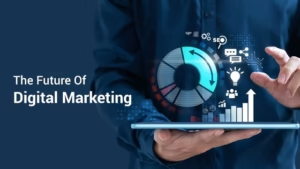
Digital marketing is evolving toward smarter automation, data-driven strategies, and interactive content. Future-ready brands will connect deeper with audiences and create meaningful online experiences.
Measuring What Matters: Analytics for Digital Branding

How do you know your digital branding is working? You measure it. But look beyond vanity metrics like likes and followers.
- Brand Awareness: Track direct traffic to your website, branded search volume (people searching for your company name), and social mentions.
- Brand Engagement: Measure time on site, pages per session, social media engagement rate (comments, shares, saves), and video completion rates.
- Brand Sentiment: Use social listening tools to analyze not just if people are talking about you, but what they are saying. Is the sentiment positive, negative, or neutral?
- Conversions: Ultimately, strong digital branding should drive action. Track conversions that matter: newsletter signups, demo requests, and sales.
The Cognitive Shortcut: How World-Class Digital Branding Programs the Mind for Loyalty
We encounter thousands of brand messages daily. The human brain cannot critically evaluate each one. Instead, it relies on shortcuts—heuristics and emotional impressions—to make decisions. This is the true battleground of modern Digital Branding.
It’s not a battle of logos; it’s a battle of neural pathways. Superior Digital Branding is the deliberate process of creating positive, consistent cognitive shortcuts that make your brand the default choice for your customer. This isn’t about being the “best” in an objective sense; it’s about being the most mentally available and emotionally resonant. This article dissects the neuroscience and strategy behind building a brand that captivates the subconscious.
The Neurological Blueprint: How the Brain Processes a Digital Brand
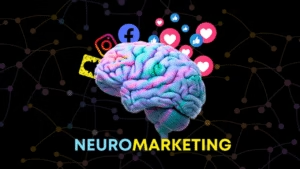
To master Digital Branding, you must first understand the instrument you are trying to influence: the human brain.
Cognitive Ease: The Gateway to Trust
Nobel laureate Daniel Kahneman identified “Cognitive Ease” – the human tendency to prefer things that are easy to think about. When a brain encounters something familiar, simple, and coherent, it registers a positive feeling. When it encounters complexity, dissonance, and confusion, it triggers “Cognitive Strain,” leading to distrust and avoidance.
Your Digital Branding is either an engine of Cognitive Ease or a source of Cognitive Strain.
A website with intuitive navigation and clear messaging creates Cognitive Ease.
A social media feed with a consistent visual theme creates Cognitive Ease.
A brand voice that is recognizable across all platforms creates Cognitive Ease.Every point of friction in your digital presence—a confusing checkout process, inconsistent color schemes, jargon-filled copy—forces the user’s brain to work harder. This subtle strain erodes trust before a single word of your value proposition is processed. The foundational goal of any Digital Branding strategy must be to systematically eliminate cognitive strain.
The Primacy of Emotion in a Rational World
Neuroscience confirms that emotion is the primary driver of decision-making, with logic often employed post-hoc to justify emotional choices. A powerful Digital Branding strategy targets the limbic system—the brain’s emotional core—first and foremost.
What emotional state do you want your customer to associate with your brand?
Security and Trust? (Crucial for financial or health-related brands)
Joy and Inspiration? (Effective for creative, travel, or lifestyle brands)
Confidence and Capability? (Key for B2B and software companies)This emotional signature must be consciously designed and woven into every aspect of your Digital Branding, from the imagery you select to the stories you tell. Your brand is not a list of features; it is a curated feeling.
The Architecture of Mental Availability: Building Your Cognitive Footprint
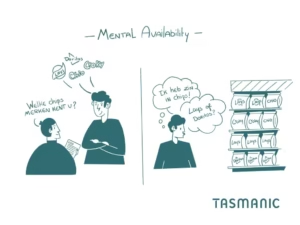
“Mental Availability” is the probability that a buyer will think of your brand in a buying situation. Your Digital Branding is the tool that builds this availability.
The Signature Story System
Every brand has a story, but most tell it statically—an “About Us” page written once and forgotten. World-class Digital Branding treats storytelling as a dynamic, modular system.
Your brand’s narrative should have three layers:
The Origin Story: The foundational myth. Why you started, the problem you saw, the struggle you faced. This creates relatability.
The Manifesto Story: The ongoing mission. This isn’t what you do, but what you believe. It’s a persuasive argument for your worldview that your customers can adopt as their own.
The Proof Story: The continuous stream of evidence. Customer success stories, behind-the-scenes of product development, employee spotlights. This validates your origin and manifesto.This “Signature Story System” ensures your narrative is always evolving and providing fresh, authentic content that reinforces your core Digital Branding message, making your brand more mentally available across a wider range of contexts.
Sensory Branding in a Digital Space
We think of the digital world as a visual and auditory medium. But the most advanced Digital Branding strategies hint at a multi-sensory experience, triggering the brain’s sensory cortex to create a deeper, more memorable impression.
Visual: Beyond a logo, this is your motion design. How do elements animate on your website? Is it smooth and graceful, or sharp and energetic? This non-verbal communication is a powerful component of your Digital Branding identity.
Auditory (Sonic Branding): The unique sound of a notification in your app, the intro music to your podcast, the audio logo at the end of your videos. Consistent sonic cues build recognition without a user ever having to look.
Haptic (The Illusion of Touch): Through language and visual design, you can evoke tactile sensations. Describing your software as “smooth,” “seamless,” or “frictionless” uses haptic metaphor. Using imagery of luxurious textures (wood, fabric, metal) in your visuals can trigger similar associations.This multi-sensory approach to Digital Branding creates a richer, more textured mental model of your brand in the customer’s mind.
The Fluidity Framework: Adaptive Consistency in a Fragmented World

The old model of consistency was rigid: the same message, everywhere. The modern model is fluid: a consistent core identity that adapts intelligently to different contexts without losing its essence. This “Fluidity Framework” is the future of resilient Digital Branding.
Channel-Specific Personas
Your brand has one core personality, but it should express different facets of that personality on different platforms, much like a person acts slightly differently at a professional conference versus a backyard barbecue.
LinkedIn Persona: The Thought Leader. This is the professional, authoritative, and insightful facet of your brand. Content is value-driven, data-backed, and industry-focused.
Instagram Persona: The Inspirer. This is the visual, aspirational, and behind-the-scenes facet. The tone can be more personal, emotive, and story-led.
TikTok/Reels Persona: The Entertainer. This is the authentic, unpolished, and trend-savvy facet. It’s about quick value, humor, and cultural relevance.This is not inconsistency; it’s sophisticated adaptation. It demonstrates a deep understanding of each digital ecosystem, making your Digital Branding feel native and welcome rather than forced and generic. A fluid Digital Branding strategy feels “at home” everywhere it lives.
The Dynamic Value Proposition (DVP)
Most companies have one static Unique Value Proposition (UVP). A Dynamic Value Proposition is a system that tailors your core message to resonate with specific audience segments at different stages of their journey.
For the Problem-Aware Segment: Your DVP might highlight the pain point. “Tired of wasting hours on manual social media posting?”
For the Solution-Aware Segment: Your DVP might highlight your unique method. “Our AI-powered scheduler is the only one that factors in optimal engagement times.”
For the Brand-Aware Segment: Your DVP might highlight your ethos. “Join 10,000+ creators who believe in working smarter, not harder.”This requires a deep understanding of your audience clusters, but it results in a Digital Branding message that feels personally crafted for each user, dramatically increasing its persuasive power.
The Immunity Shield: Building a Brand That Withstands Crisis

A brand’s true strength is tested not during success, but during failure. Proactive Digital Branding builds what we call an “Immunity Shield”—a reservoir of public goodwill and trust that protects you when things go wrong.
The Vulnerability Dividend
Traditional branding is about projecting strength and perfection. Modern, psychologically-aware Digital Branding understands the power of strategic vulnerability.
Being open about a mistake, transparent about a product delay, or honest about a challenge you’re facing does not weaken your brand; it humanizes it. This “Vulnerability Dividend” builds a deeper, more empathetic connection with your audience. When you are authentic about your imperfections, customers are more likely to forgive you when a real crisis hits. This is a critical, yet often overlooked, function of strategic Digital Branding.
Pre-Emptyive Storytelling
This is an advanced Digital Branding technique that involves addressing your potential weaknesses or criticisms before your competitors or customers can.
If your product is more expensive, don’t hide it. Build your Digital Branding around the value and craftsmanship that justifies the price. “Why We Charge a Premium – The Cost of Ethical Manufacturing.”
If you’re a new startup, don’t pretend to be a giant. Build your Digital Branding around the agility and fresh thinking that your size allows. “The Advantage of Being Small – How We Pivot Faster for Our Clients.”By controlling the narrative around your potential vulnerabilities, you disarm critics and frame your “weaknesses” as conscious choices and strengths. This builds immense credibility and makes your brand far more resilient to attacks.
The Metric of Emotion: Measuring What Truly Matters
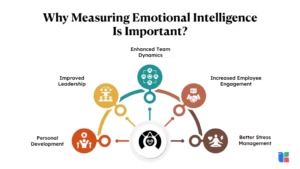
If Digital Branding is about building cognitive shortcuts and emotional connections, how do we measure it? We must move beyond vanity metrics to what we call “Emotional KPIs.”
The Net Emotional Value (NEV): Similar to NPS, but more nuanced. After an interaction, ask: “How did this experience make you feel?” with a list of emotional adjectives (Empowered, Frustrated, Confident, Indifferent). Track the ratio of positive to negative emotional responses.
Brand-Driven Search Volume: The percentage of your direct website traffic and branded keyword searches. This is a pure measure of mental availability.
Content Engagement Depth: Don’t just track page views. Track scroll depth, video completion rates, and time-on-page for your key content. This indicates whether your Digital Branding and content are creating Cognitive Ease and holding attention. - Unaided Brand Recall in Surveys: Periodically survey your target market (even a small sample) and ask: “What brands come to mind when you think of [your industry]?” This is the ultimate test of your brand’s cognitive footprint.
Conclusion: Your Brand is a Living Story
Building a powerful digital branding presence is a marathon, not a sprint. It requires consistency, patience, and an unwavering commitment to your core identity. It’s about showing up, day after day, and adding value to your audience’s lives.
Remember, your digital branding is the sum total of every single interaction a person has with your company online. From the Google search result they click, to the design of your website, to the tone of your customer service reply, to the value in your Instagram post—each touchpoint is a chapter in your story.
Make it a story worth reading. Make it a story worth sharing. Make it a story that is authentically, uniquely, and powerfully yours. Begin your odyssey today. Audit your touchpoints, revisit your “Why,” and start building a digital branding legacy that doesn’t just capture attention, but captures hearts and minds.